Social AF, together with our partners at Givepanel and Bluestep, hosted a webinar to share everything we’ve learned about virtual challenges in 2024.
Between us, we’ve helped hundreds of nonprofits achieve their fundraising goals through social fundraising campaigns over the past year.
The webinar shared 7 lessons, covering marketing and ads, incentives, how to maximise engagement with expert moderation, and explored how income is raised across different fundraising platforms during the lifetime of a social fundraising challenge.
Here’s the insights Social AF shared during the webinar:
Say goodbye to the ‘Featured’ section
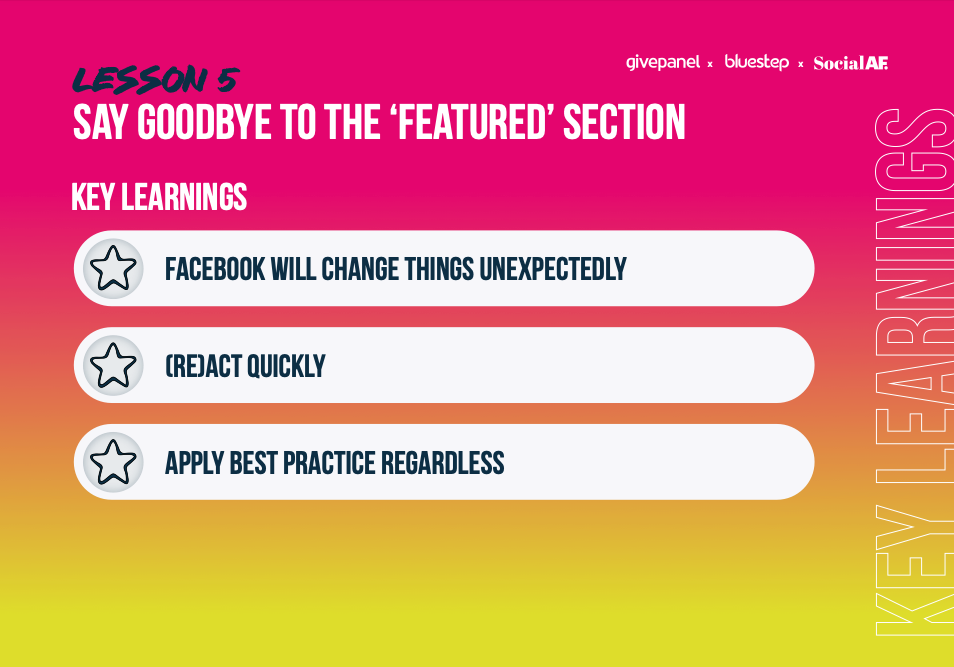
The disappearance of the ‘featured’ section on Facebook groups earlier this year was a stark reminder that Facebook can change its features unexpectedly. In the past, the featured section was a go-to spot to highlight key events or fundraising registration posts, but without it, the approach to guiding supporters through the registration process has shifted. With Facebook’s changes, fundraisers can no longer rely on this section to be visible on mobile devices. To adapt, nonprofits have focused on other ways to convert new members into active fundraisers.
To ensure a smooth registration process even without the featured section, consider these strategies:
- Update the Group’s Header Image: Add clear step-by-step instructions such as:
- Step 1: Join the Group
- Step 2: Click Featured to Complete Registration
- Use the “Add Everyone” Feature: On Mondays, when traffic peaks, remind group members to register by tagging everyone in a post. This will not only encourage action but also bring the post to the top of the group’s feed.
- Enable the New Member Intro Feature: Set up a brief welcome message that directs new members straight to the registration form or featured section.
- Update the Group’s “About” Section: Ensure that the registration link is prominently displayed, making it easy for new members to find and register.
- Post Daily Welcome Messages: Each day during the recruitment phase, post a midday message welcoming new members and encouraging them to complete their registration.
While Facebook may change its features again, these strategies—shared by Social AF—along with reacting quickly and having a plan in place, can ensure that your registration process remains smooth and that your supporters remain engaged, even if the ‘featured’ section does not return.
@Everyone for the win
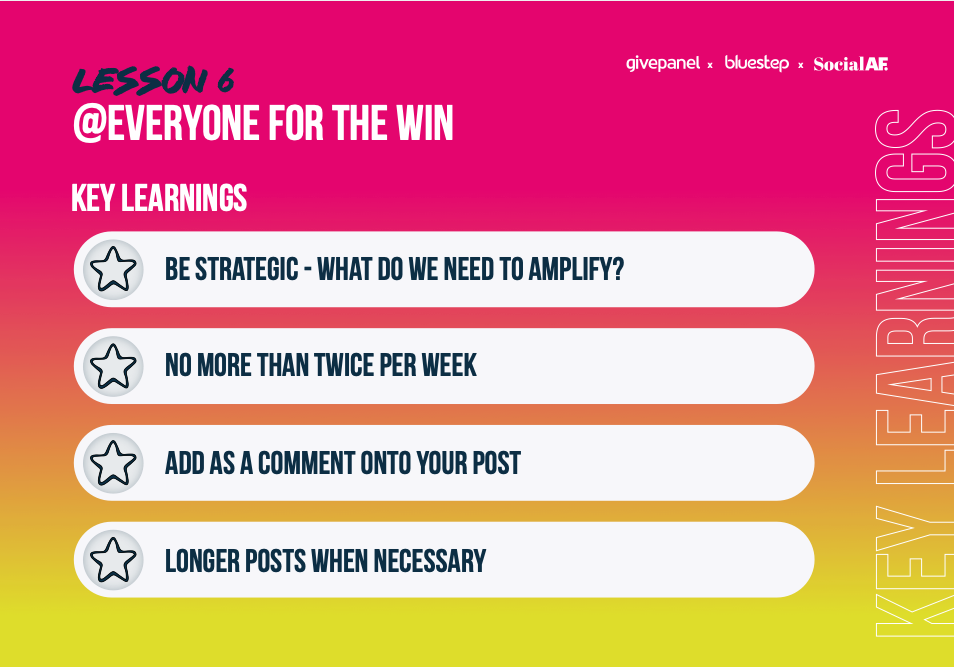
The @everyone tag is a powerful tool that can significantly boost engagement in your Facebook group, especially when used strategically. Introduced at the end of 2023, it replaced the “announcement” feature, offering a more effective way to notify all group members. When you tag everyone, the notification appears in their feed, ensuring maximum exposure for important posts.
Here are some tips from for using @everyone effectively:
- Use it strategically: Review the group each week to identify areas needing more attention, such as engagement or registrations. Use @everyone to direct focus to posts that need extra visibility, such as a fundraising push or an incentive announcement.
- Don’t overuse it: Limit use to once or twice a week. Overusing it can cause members to disengage or unfollow the group. It’s best to save it for posts that need a big push.
- Engagement booster: For example, we used @everyone to ask group members to comment on a fun post, such as “What breed is your dog?” This garnered 635 comments and significantly boosted engagement.
In our experience, the timing and content of your @everyone posts matter. For instance, for a fundraising challenge post, we added @everyone as a comment below the main post to encourage participation without disrupting the flow. This approach helped us get responses and engagement without overusing the tag.
A great example of @everyone’s effectiveness comes from a dog-walking Challenge for Samaritans. After using @everyone for a post about dog breeds, we saw a £2000 spike in income, demonstrating that fostering conversation in the group can directly lead to increased fundraising.
By using @everyone thoughtfully, you can create more engaging content, increase participation, and ultimately drive more donations.
Benchmarking multi-platform income
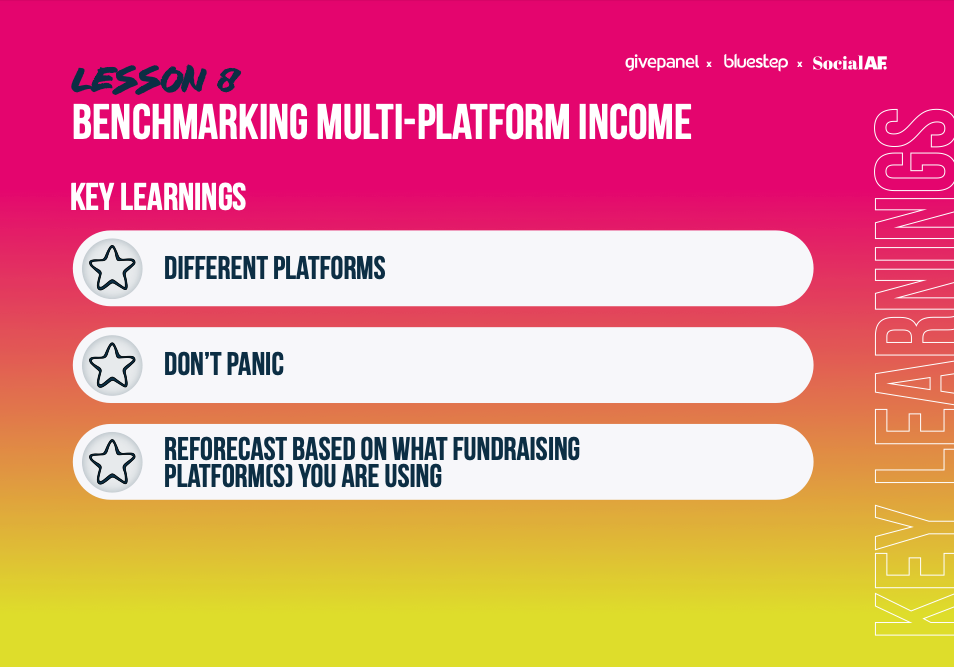
As fundraising moves to a mix of platforms, it’s critical to track and benchmark your income across them to ensure your strategy is data-driven. From 2023 onwards, platforms like JustGiving have started to raise more income than Facebook, with Challenges seeing a split of 60-40 or even 70-30 in favor of JustGiving.
But how does that income differ across the Challenge timeline?
Our insights show that during the recruitment phase, Facebook fundraisers tend to generate income earlier, as they immediately share on participants’ timelines, encouraging faster donations. In contrast, JustGiving fundraisers typically start raising income on the first day of the Challenge, meaning benchmarks based on Facebook-only performance can lead to inaccurate expectations. For example, if a Challenge raises £400,000, a Facebook-only benchmark might predict £120,000 by the recruitment phase, while JustGiving may only bring in £30,000. However, by week five of the Challenge, income across platforms tends to align, with a slight spike in the final week for Facebook-based campaigns.
Key Takeaways:
- Revise Benchmarks: Don’t rely on Facebook-only benchmarks—adjust them for the platforms you’re using.
- Track Performance Across Platforms: Income from different platforms behaves differently during the recruitment phase, but it starts to even out as the Challenge progresses.
- Final Week Uplift: Facebook and hybrid campaigns often experience a larger income increase in the last week, whereas JustGiving campaigns tend to raise most of their funds earlier.
Did you miss the live webinar?
It’s not to late to catch up on the webinar, you can watch here! 👇
https://lnkd.in/eCt8jtwN
Passcode: 2HP4=V?N