Sometimes, the best way to improve your social media strategy is to stop doing something the way you’ve always done it.
Georgia, Virtual Challenges Operations Manager at Social AF, has written this blog to share why we are changing up the way we welcome new supporters into Facebook challenge groups, what we’ve tested and, most importantly, what the results so far have told us.
When you work with virtual challenges day in, day out, you get used to certain things becoming part of the routine.
You know when to post, what information supporters need, what tends to get people chatting and which little tactics can help keep a challenge moving.
But sometimes, you have to stop and ask yourself: is this still working?
That’s exactly what I found myself asking about our Facebook welcome posts.
For years, welcome posts have been a familiar part of Facebook challenge groups.
As a Facebook group grows during the recruitment month, charities post warm welcome posts each day, sharing the registration link, tagging the newest members and adding a cheerful GIF. It’s a simple way to acknowledge new supporters and encourage them to take the next step – registering for the challenge and activating their fundraising page.
But what happens when those posts stop getting the engagement they once did?

The traditional approach
Our “old school” welcome posts followed a familiar formula.
Every day at lunchtime, we would:
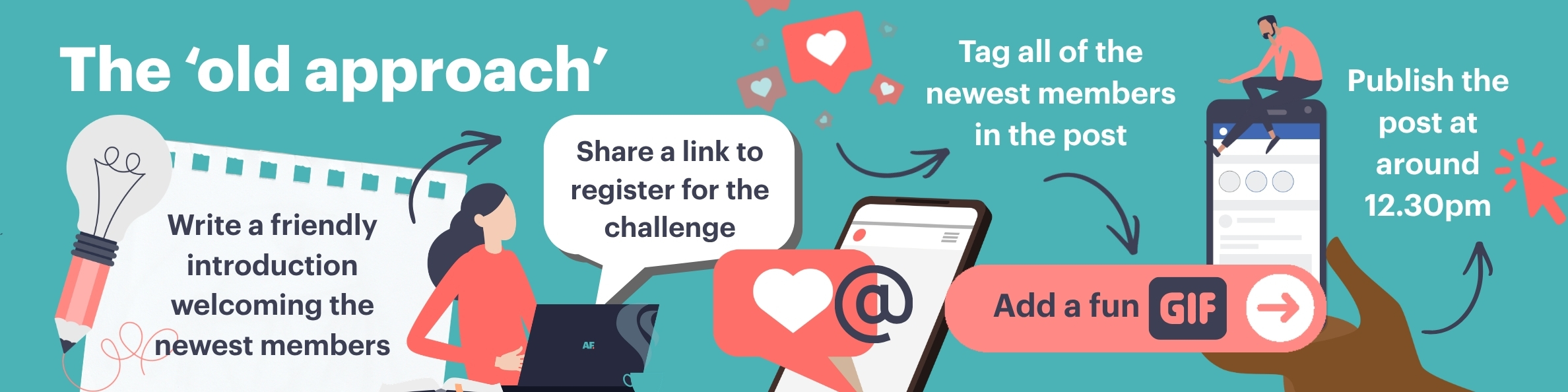
It had worked well historically, but over the past 12–18 months, we’d noticed something changing.
Engagement was dropping.
When you’re looking at a Facebook group on your phone, a post containing a lengthy introduction followed by a long list of tagged names isn’t necessarily the most eye-catching thing in your feed. People may need to click “See more” before they even get to the names, and by that point, they may have already scrolled past.
Our gut feeling was that the posts had simply become too long and too wordy. Peoples’ attention spans are getting shorter, so in order to boost engagement, our posts needed to be shorter, snappier and have a clear call to action.
So rather than relying on our gut feeling, we decided to test it out.
Putting our theory to the test
We ran an experiment during the recruitment period for Prostate Cancer Research’s September challenge.
Instead of using our usual welcome post every day, we alternated between the traditional format and a much simpler new approach.
The new-style posts stripped things right back. Rather than introducing and tagging every new member, we used Facebook’s coloured backgrounds to create a short, eye-catching call to action.
Something along the lines of:
“Are you new around here? Make sure you register to take part and get your free T-shirt by clicking this link (LINK)!”
We varied the wording slightly from post to post to keep things fresh, but the principle stayed the same:

We also removed the daily tagging of new members. Our aim wasn’t to assume that the new approach would work. It was to find out.
And the results were clear
We tracked the performance of both types of post throughout August, looking at engagement as well as the uplift in registrations.
The new-style welcome posts came out on top.
Registrations
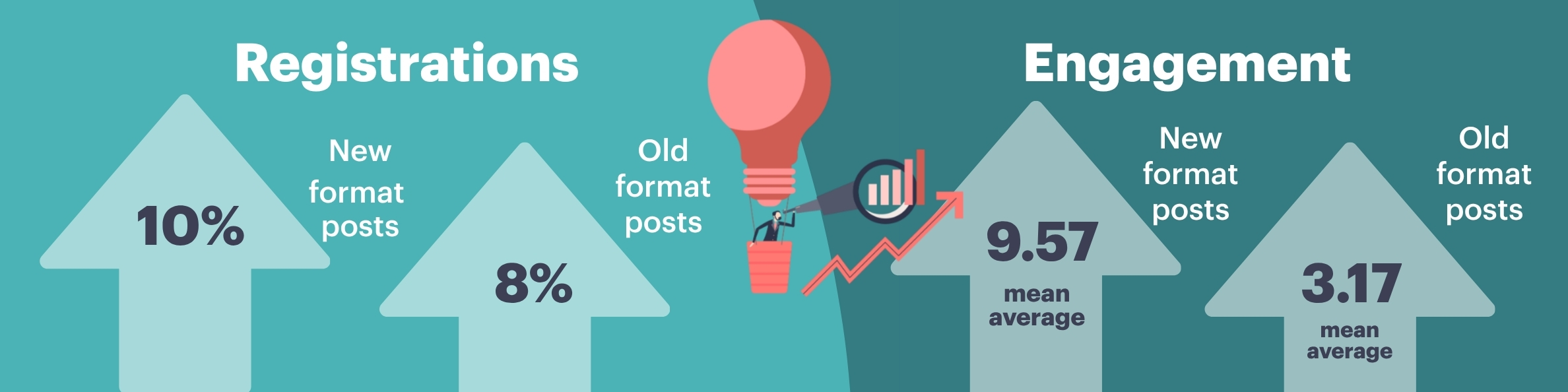
The new-style posts generated an average 10% increase in registrations.
The traditional welcome posts generated an average 8% increase.
That’s a 2 percentage point difference in registration uplift, which is a meaningful result when you’re repeatedly promoting a fundraising challenge to a large community.
Engagement
The difference in engagement was even more noticeable.
The new-style posts achieved an average engagement figure of 9.57, compared with just 3.17 for the traditional posts.
In other words, the shorter, simpler posts weren’t just generating more registrations, people were interacting with them more too.
Less work, better results
There was another unexpected benefit to changing the format: it made the process much easier for our team.
The traditional posts actually involved a fair amount of daily admin.Team Leaders needed to check the newest members, create the post, tag people and deal with any Facebook glitches that occurred during the tagging process.
The new format removed much of that. There was no need to compile and tag a list of new members, and the posts could be created and scheduled much more quickly.
So we’re seeing a win on both sides: Better performance for supporters and less admin for the team, yay!

What does this tell us about social media?
The biggest lesson isn’t necessarily that every charity should ditch its traditional welcome posts.
It’s that we shouldn’t assume something is working just because it’s always worked.
We know that social media behaviour changes.The way people consume content changes. Platforms change and algorithms change. And of course, our audiences change.
A format that performed brilliantly two or three years ago might not have the same impact today, so that’s why testing really matters.
Instead of making a major change based purely on instinct, we were able to compare two approaches running alongside each other and look at what actually happened.

Keep testing your supporter journey
Welcome posts might seem like a small part of a virtual challenge, but every interaction with a supporter is an opportunity.
A welcome post can be a chance to:
- Make a new supporter feel part of the community
- Encourage them to register and start fundraising
- Drive them towards their fundraising journey
- Increase engagement within the group
- Build excitement around the challenge

That makes it worth looking at how these touchpoints are performing and whether there’s an opportunity to make them more effective.
Our experiment has shown us that, for this particular challenge, a shorter, more visual and more direct approach performed better than our traditional format.
And that’s the beauty of testing, you don’t have to guess what your audience wants.
You can try it, measure it and learn from it. We hope this is helpful.