AI is everywhere at the moment.
For charities, like many other organisations, there are obvious reasons to explore what AI might be able to do. It can help teams work more efficiently, process information and automate certain tasks.
But when it comes to responding to charity supporters, we believe there is a much bigger question to ask than simply, “can AI do this?”
We need to ask, should it?
For us, the answer is clear and we have recently shared our stance on the use of AI on our LinkedIn page, which received lots of thoughtful discussion in the comments section.

We have no plans to use AI to write responses to supporters and audiences or to replace our human moderators.
That isn’t because we’re anti-technology. We use technology every day to help our team work effectively and safely It’s because we believe there are some interactions where the human element isn’t an optional extra.
Behind every comment is a person
It’s easy to think of social media moderation as just responding to comments, but that’s not really what good moderation is.
Behind every comment is a real person. Sometimes they’re excited about taking part in a challenge. Sometimes they’re asking a straightforward question. Sometimes they’re frustrated, or they might be celebrating. And sometimes they’re having an incredibly difficult time.
One of the responses to our recent LinkedIn post came from Emma, who had recently started working in social media moderation. She summed it up simply:
“Behind every comment is a real person, and sometimes simply feeling heard, understood and responded to with genuine empathy can make all the difference.”
That’s what we’re always trying to achieve through moderation.

Context matters
A good moderator doesn’t just read the words on a screen – they consider the context behind them.
What has this person said previously? What is happening in the wider conversation? What do we know about the charity they’re representing? Is there something in the way they’ve phrased their comment that suggests they need a different kind of response?
Those things aren’t always obvious from a single sentence.
Borys, one of our former Social AF moderators, shared his experience of this on LinkedIn. He highlighted the importance of lived experience and the ability to understand the wider context of a conversation.
He also made an interesting point about efficiency.
From his experience on the ground, using AI to dissect a conversation and help formulate a response wouldn’t necessarily have saved him any time. It could actually have created another step in a process where supporters need a response quickly and where the moderator already has the experience and judgement to know how to respond.
That’s an important part of this conversation. Technology isn’t automatically better just because it is faster. Sometimes the most effective tool is a person who understands the situation in front of them.

What happens when the conversation is deeply personal?
This is where our concerns about AI-powered responses become particularly significant.
Charity communities aren’t always straightforward customer-service environments. Someone might be recently bereaved. They might be worried about symptoms, or have just received a diagnosis.They might be recovering from an illness or treatment. They might be struggling with their mental health.
Maybe they’re annoyed because they’ve accidentally made a different donation than they intended, or simply not know what to do next with their fundraising page.
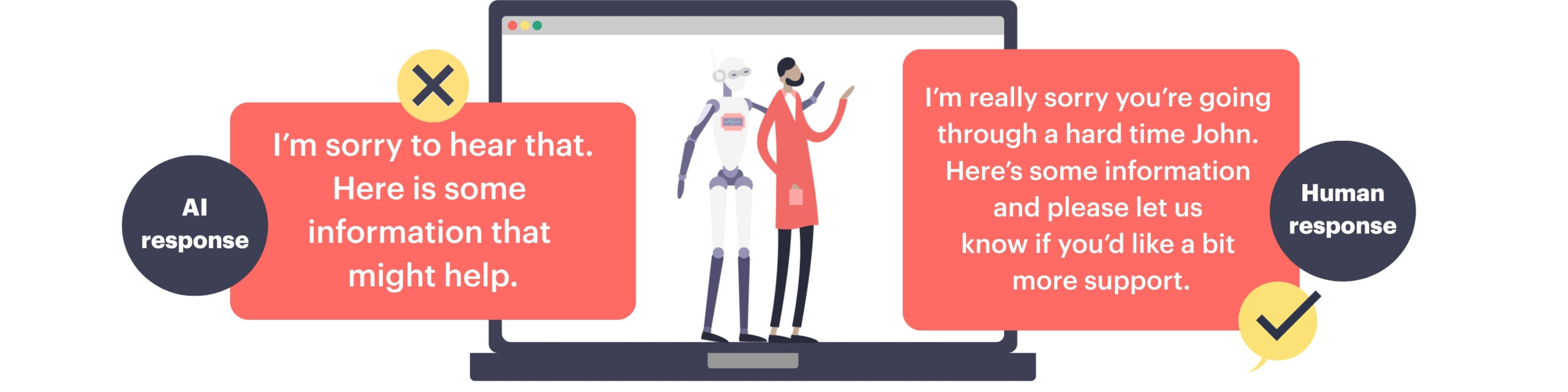
In those moments, getting the information right isn’t necessarily enough. The response needs to recognise the real person making those comments.
Laura-Anne, one of our moderators, gave some powerful examples when she responded to our LinkedIn post. She asked us to consider how an AI response might feel to someone experiencing brain fog following chemotherapy, recovering from a stroke, dealing with fresh grief or panicking about a fundraising problem.
These aren’t hypothetical issues for charities, these are real people, having real conversations, in real moments of their lives.
A response can be factually correct and still feel completely wrong, because it can miss the tone, overlook something important or can offer a generic reassurance when what someone actually needs is to feel understood.
And that’s why we don’t think this is simply a question of whether AI can produce a convincing response.
It’s about whether that response is appropriate for the person being receiving it.
People deserve to know who they’re talking to
There’s another part of this conversation that we think deserves more attention, and that is transparency.
If AI is being used to respond to a supporter, we believe that person should know. People deserve to understand whether they’re having a conversation with another person or with a machine.

Without that transparency, there is a risk of damaging the trust that charities work incredibly hard to build.
Charities ask supporters to share their stories, their experiences, their time and often their money. That relationship is built on trust. So we think it’s reasonable for supporters to expect honesty about how their interactions are being handled.
There are also wider questions around privacy and how personal conversations are used when AI tools are involved. If someone shares something deeply personal in what they believe is a private charity community, what happens to that information? Where does it go? How is it stored? Is it being used to generate responses? Did the person sharing it understand that this could happen?
These are questions that shouldn’t be brushed aside simply because the technology is available.
We’re not anti-AI

We want to be clear about this. Our position isn’t that AI has no place in the charity sector.
We see how it may be useful. There are ways technology can help teams work more efficiently, improve processes and support people doing important work.
We’ll continue to use tools where they genuinely help our team work effectively and safely.
But there’s a difference between using technology to support people and using technology to replace human interaction.
For us, social media moderation sits firmly in the second category.
We don’t want AI writing our responses to supporters. We don’t want AI replacing the people who build relationships with communities. Our moderators aren’t just people sitting behind a screen answering comments.
They’re real people with real charity-sector experience, so we don’t have to use scripts to generate individual responses. Our moderators use their own judgement.
Charity is about people

The technology around social media will continue to change. AI will become more sophisticated and ew tools will emerge. The ways charities communicate with their supporters will therefore have to evolve.
But we don’t think progress should mean losing sight of what makes charity communities special in the first place. When someone reaches out to a charity, they’re not a prompt. They always deserve to feel heard, understood and treated like a person.