
If your social media feeds are anything like ours, you will have been inundated with virtual challenge ads from charities encouraging you to sign-up to their latest virtual challenge event.
Each year, virtual challenges raise millions for good causes and are a vitally important income line. So when you consider the importance of their performance, and the steady stream of competition you would assume that consideration would be given to how the ads are managed.
Yet, despite the potential return on investment, we often see that a key part of ad performance is ignored. And that’s moderation. If you are unsure what we mean, the next time you see a paid charity ad, open the thread to read the comments. It may surprise you how many charities allow their feeds to self-moderate and leave questions unanswered.
Within this blog, we’ll explore our top three reasons why we believe moderating virtual challenge ads as essential and we’ll also give some tips on how to moderate them well.

Why challenge ad moderation is essential
It allows you to seize interest before they go elsewhere
We already know that the best-performing virtual challenges are simple concepts. Very few challenges are truly unique, which means you’ll have competition. Not necessarily in terms of your particular cause/mission, but certainly in terms of the challenge you’re recruiting for.
Let’s say one person is looking to take part in a challenge and raise funds for a breast cancer charity. Within one day they’ve been served four different ads, for four different challenges. They ask a question on each ad set, but only get a response to one. Which challenge do you think they’re more likely to sign-up for?
It shows you’re genuinely invested in the whole process, and not just the end result
Effective ad moderation isn’t just about dealing with negativity, hiding complaints and protecting the integrity of your charity’s reputation. It is also about fostering meaningful engagement, building excitement and letting people know you’re genuinely grateful for their support.
By engaging with supporters early, you’re setting the relationship up for the best possible chance at success.
Comments in challenge ads gives you vital insights which can help you in the future
Paid ad insights are truly fascinating. Because ads use a wide audience they can give you an insight into how some members of the public view you. We’ve recently seen a lot about CEO salary and how funding is spent. It doesn’t take long for misinformation to spread, which can potentially be damaging. By having a presence and actively monitoring comments, you can quickly correct people in a positive way.
Ads can also give you indications on how visuals/language is landing with the public. For example, we recently moderated a Facebook challenge ad campaign and one of the best-performing ads included an image of a cyclist who wasn’t wearing a helmet. This ad performed well in terms of reach, had high volumes of comments and a good level of leads, however, the vast majority of the conversation was actually about the importance of wearing a helmet and not about the challenge.
The image was changed and ultimately the new ads helped drive better conversions. This wouldn’t have been possible if the comments weren’t being monitored.

Respond to as much as possible
A lot of what you see with virtual challenge ads will be what we refer to as “tags”. This is essentially where someone has seen an ad, and tagged their friend/family member in the ad to help draw attention to it.
We are big advocates of taking the time to say thank you. At the very least, the person who has seen that ad has taken time out of their day to raise awareness, and essentially say to a friend “you might be interested in this.” Saying thank you acknowledges their effort as well as opens up the lines of communication should either of them have any questions.
We would also respond to any questions about the challenge/charity, any comments where people have shared their thoughts on the charity or previous interactions, and any comments from people who have taken the time to share some of their story.
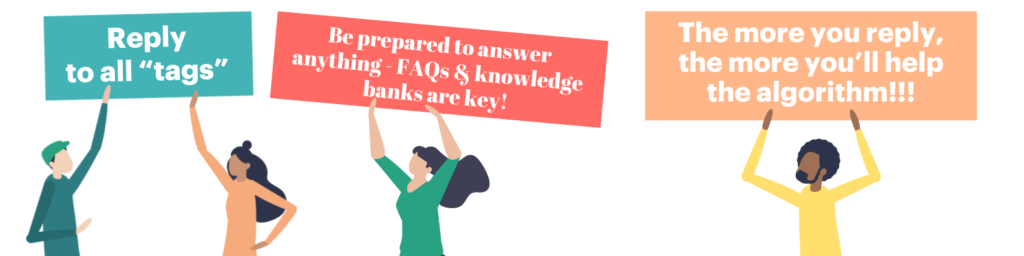
Let’s not forget that comments are King when it comes to Facebook. The more you reply, the more you’ll help the algorithm.
Be personable/add humour
Being personable in replies, doesn’t need to be overly complicated. Often it’s as simple as including the name of the person who has posted in your reply, to show you are not a robot.
We often like to top and tail responses which include signposting or standard FAQ replies. This process helps ensure the vital information is shared, but means you can create variety within the feed.
Another thing we’re fans of, is adding humour. Challenge ads can often be great places for this, as sometimes people will take you by surprise and say some very funny things. Of course, the other side of that is that some people can comment with very unhelpful things, but replying to these with humour is a good way to inspire interest in others.
Be prepared to answer anything
There isn’t a blog on our website which doesn’t try and advocate for FAQs or knowledge bases. They are so helpful when it comes to any form of social media moderation and will massively help you when it comes to moderating challenge ads.
We’ll often see the weird and the wonderful on paid ads. The more prepared you are to answer the better.
If your charity needs help with ad moderation, or any other aspects of this blog please do get in touch.